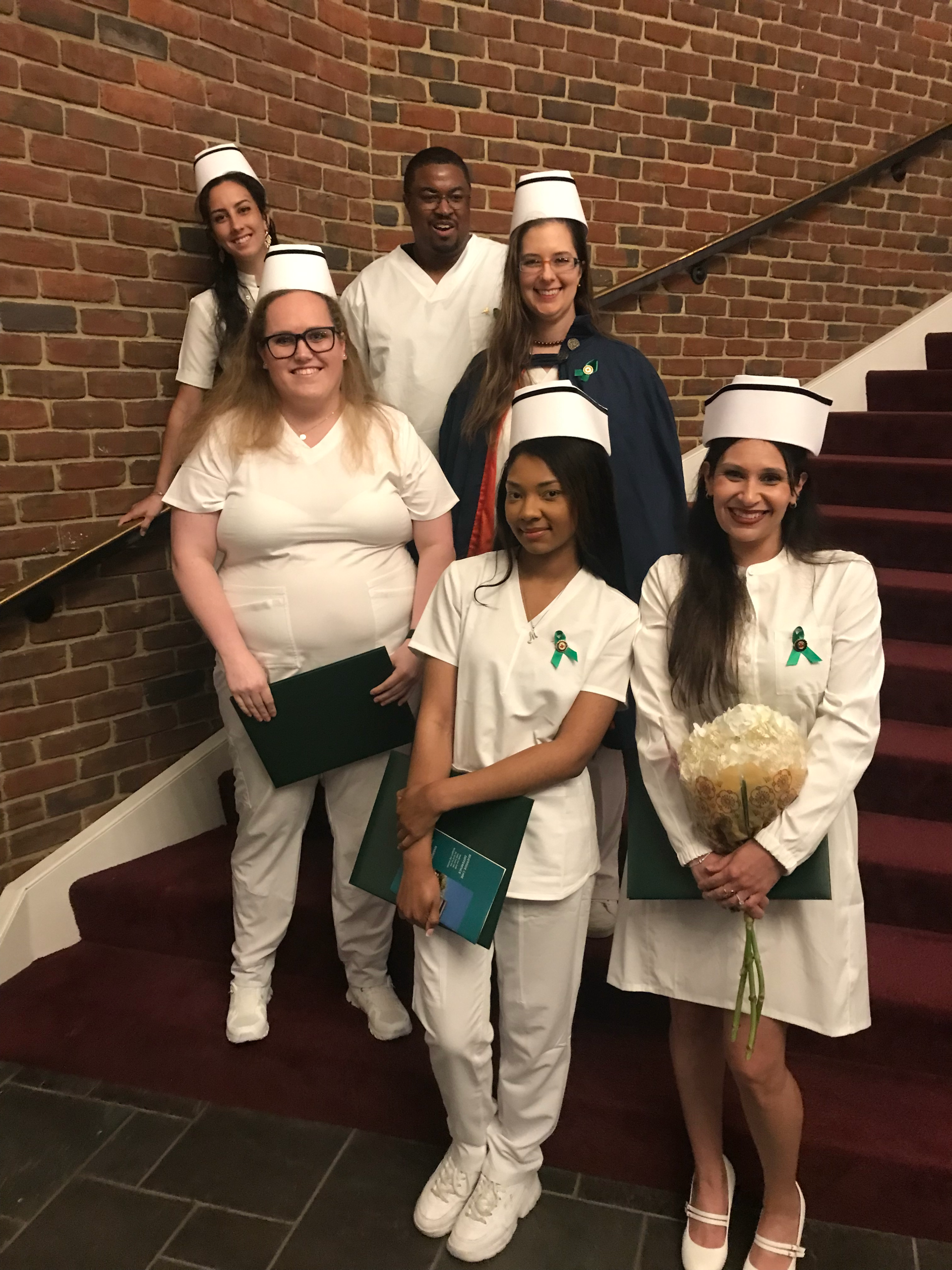
Philosophy of Nursing
Rebecca Capehart-Freire, RN
Macon and Joan Brock Virginia Health Sciences at Old Dominion University
NURS 401: Introduction to Professional Development for Baccalaureate Nursing
Dr. Holly Tenaglia
November 9, 2025
Philosophy of Nursing
I always like asking my patients, “How are you feeling today?” On the Medical-Surgical Unit where I worked, they were not used to this question and sometimes asked for clarification. I would explain that there are vital signs everyone tracks: temperature, pulse, oxygenation, blood pressure, and respiration rate. Some people believe that your intake and output are so telling that they should also be one of the vital signs. I believe that your mood is so important that it should be one of the vital signs. Research has shown that a person’s level of optimism and emotional stress can affect healing. That is where my personal philosophy of nursing starts: mood. I also believe in service, education, and honesty.
Student’s Definition of Nursing
From the American Nurses Association (ANA) Scope of Practice (2021), we have an excellent answer to the “what” and “why” of nursing:
Nursing is the protection, promotion, and optimization of health and abilities; prevention of illness and injury; facilitation of healing; alleviation of suffering through the diagnosis and treatment of human response; and advocacy in the care of individuals, families, groups, communities, and populations… The profession exists to achieve the most positive patient outcomes in keeping with nursing’s social contract and obligation to society.
Purpose of Nursing
One day, in late 2007, I was driving to my job as a Costume Master and a hymn from church got stuck in my head, “Have I Done Any Good?” (2025). The more I thought about it, I hadn’t really done any good in the world that day. It had been a few days since the last time I did something that felt like real service to mankind or the planet. After that job, I expanded my search to include jobs that felt more like service. My next employer was the Los Angeles Homelessness Services Coalition, a 501(c)3 nonprofit fighting to save homeless children in Los Angeles County. I worked there for two years before the Great Recession shut the doors temporarily and we all needed to find new employment. I really love helping people. I always want to be actively doing good in the world. My favorite part of nursing is watching people get better. It lifts me up and makes me feel like I’m floating to watch someone’s progress and have measurable results of it, which might be why I feel drawn to wound care.
I believe that education is the key to so much that nurses do. Without being educated in a patient’s health history, we cannot give a patient all their options. Without education, we do not know the possible side effects to watch for with medical treatments. I have also found that education is the best way to convince a patient to make lifestyle changes to improve their quality of life. I believe in kindness, but I always choose honesty with kindness. I had to give hard facts about safety to one of my siblings recently. I knew she did not want to hear them. I ended by saying, “I don’t care if you are mad at me. I need you to be not dead.” I am working on delivering honest information tactfully to remain ever kind.
Mood and honesty are important, but sometimes in conflict, which I will discuss more later. I always like to ask my patients what their mood or level of optimism is. I have never found a place to put this information in a chart, so I always include it in my nursing notes. I received feedback once from a nurse practitioner who said she likes my notes because she knows the mood of the room before walking in. It definitely started with the 1998 movie Patch Adams and learning about research into mood affecting outcomes from the 1950s. Today, much research is being done showing positive results from studying the moods of both nurses and patients in holistic, mindful care (Cowling, W. R., 2023).
Nursing Relationships
In some cultures, medical staff do not tell a sick person what their diagnosis is. The nearest family member is told instead. The patient obediently takes the treatments without education and without question. Their ignorance, which is designed to lower stress levels, helps to prolong their life. I have a fervent belief in mood, but I also feel it should be up to the patient and family to decide how much they want to know. It is our job as medical professionals to respect their decisions. Also, it is always the job of the nurse to be an ally and advocate for our patients.
Leininger has transformed the way nurses interact with and listen to patients. She is one of the pioneers of Transcultural Nursing Theory with her goals of holistic and culture-specific care (2002). This is very important in a world of immigrants and refugees. It is wonderful to remember that humans have more in common than different. However, not everyone has the same views of health, wellness, and death. I like finding common ground with people and meeting them where they are. For example, I find it extremely beneficial for all parties when I can join a patient and their family in prayer. It is a great way for me to demonstrate caring for them, their religion, and their culture.
In the United States of America, nurses are one of the most trusted professions (ANA, 2024). We have a responsibility to serve our community in a way that respects and honors that trust. I personally like to drop into conversations that I’m a nurse. I appreciate the trust that I’m immediately given.
No one works in complete isolation, especially in health care. When I feel like I have the respect of my peers: it is easier to communicate difficult news, ask for more information, or ask for a favor. It is nice to have the skills to perform many tasks for my patients, but it is also time consuming. I also recognize that I have limited knowledge and experience. I am glad that there are experts in the different fields of health care that I can turn to when I need them.
Moral or Ethical Principles
I absolutely believe in a person’s autonomy if they are mentally capable of making decisions. For example, as my children age, I try to teach them to take in all of the information and explain why we make the decisions that we make so they are prepared to care for themselves someday. Patients always have the right to decline care. However, if I know that a patient has stayed in bed for two days due to fear and depression then I also know that they are at risk of developing pneumonia. So, I would address their mood and mental state to prevent pneumonia, but it is ultimately their decision.
The local wound care clinics are frequently booked out weeks or months in advance. My stepfather has a re-occurring wound in a lower quadrant of his posterior side that is hard for him to reach. His insurance company has provided him with wound care supplies, and I promised I would help change his bandages. Last week, he suffered a skin tear to his wrist and I’ve started to change the bandages on that, too. This week, cracks formed in his feet and those were added to the wound care regimen. As a family member, I know I can decline anytime, but I like helping him. As a healthcare professional, I feel this also demonstrates my fidelity to one of my favorite patients.
Conclusion
In conclusion, I prefer a holistic approach to healing that includes a patient’s mood, culture, and medical condition. I feel patient and family members are more likely to comply with education and honesty but understand when a relative has been given responsibility of a loved one’s health. Using kindness and Honesty improves mood which in turn makes a patient more receptive to education, driving better outcomes.
Reflection
Ethical dilemmas will always arise, and it is important to know my limits.
References
American Nurses Association (2024). America’s Most Trusted: Nurses Continue to Rank the Highest. Nursing World. https://www.nursingworld.org/news/news-releases/2024/americas-most-trusted-nurses-continue-to-rank-the-highest/
American Nurses Association (2021). Scope of Practice. Nursing World. https://www.nursingworld.org/practice-policy/scope-of-practice/
Cowling, W. R. (2023). Mindfulness and Meditation in Holistic Nursing. Journal of Holistic Nursing. https://doi.org/10.1177/08980101231173931
Hoge, E. A., Philip, S. R., & Fulwiler, C. (2019). Considerations for mood and emotion measures in mindfulness-based intervention research. Current Opinion in Psychology, 28, 279-284. https://doi.org/10.1016/j.copsyc.2019.02.001
Leininger M. (2002). Culture care theory: a major contribution to advance transcultural nursing knowledge and practices. Journal of transcultural nursing : official journal of the Transcultural Nursing Society, 13(3), 189–201. https://doi.org/10.1177/10459602013003005
Shadyac, T. (Director). (1998). Patch Adams [Film]. Universal Pictures; Blue Wolf Productions; Farrow/Minoff.
Thompson, W.L (2025). Have I Done Any Good? [Musical Score]. Church of Jesus Christ of Latter-Day Saints.
Honor Pledge
I pledge to support the Honor System of Old Dominion University. I will refrain from any form of academic dishonesty or deception, such as cheating or plagiarism. I am aware that as a member of the academic community it is my responsibility to turn in all suspected violations of the Honor Code. I will report to a hearing if summoned.